Job-Talent Matching: The most exciting part lies between yes and no
Tuesday, September 8, 2026
Typically, recruiting processes treat matching like a sorting task: those with the right skills move forward, while those with discrepancies are filtered out. That is exactly where the problem lies. Especially in IT recruiting, the tech stack is not the only factor that determines whether a match is realistic. A talent may be technically interesting and yet not a good fit for the job—be it due to the commute, salary expectations, workload, work model, or specific technology requirements.
Our current evaluation on seekme.io shows exactly this intermediate space. It is based on several hundred talent profiles and nearly 100 job profiles. This has resulted in over 3,000 job/talent combinations. The picture is quite clear: there are perfect matches. But there are significantly more cases where talents are fundamentally interesting but deviate on individual criteria, whereby these deviations can probably be resolved in many cases.
73% "Near-Matches"
Of the more than 3,000 job/talent combinations evaluated, only 27% were perfect matches. In the vast majority of combinations, there was at least one deviation.
This does not mean that these talents are completely unsuitable. That would be exactly the wrong interpretation.
Because the exciting thing is: between "fits" and "does not fit" lies a large area. A talent can be professionally interesting, but might not quite fit the job when it comes to the commute, salary expectations, workload, or tech stack.
And this is precisely the area that is often crucial in recruiting.
Deviations are not rejections
A deviation is not automatically a knock-out criterion. It is a signal.
Maybe the commute is a bit too long, but with more home office, the match would be perfect. Maybe the salary expectation is above the budget, but not dramatically. Maybe a specific technology is missing, but the methodological experience is very close to the job.
Good matching should make such differences visible. Not to prematurely filter out talent, but so that companies and talent understand sooner where it really fits and where it doesn't.
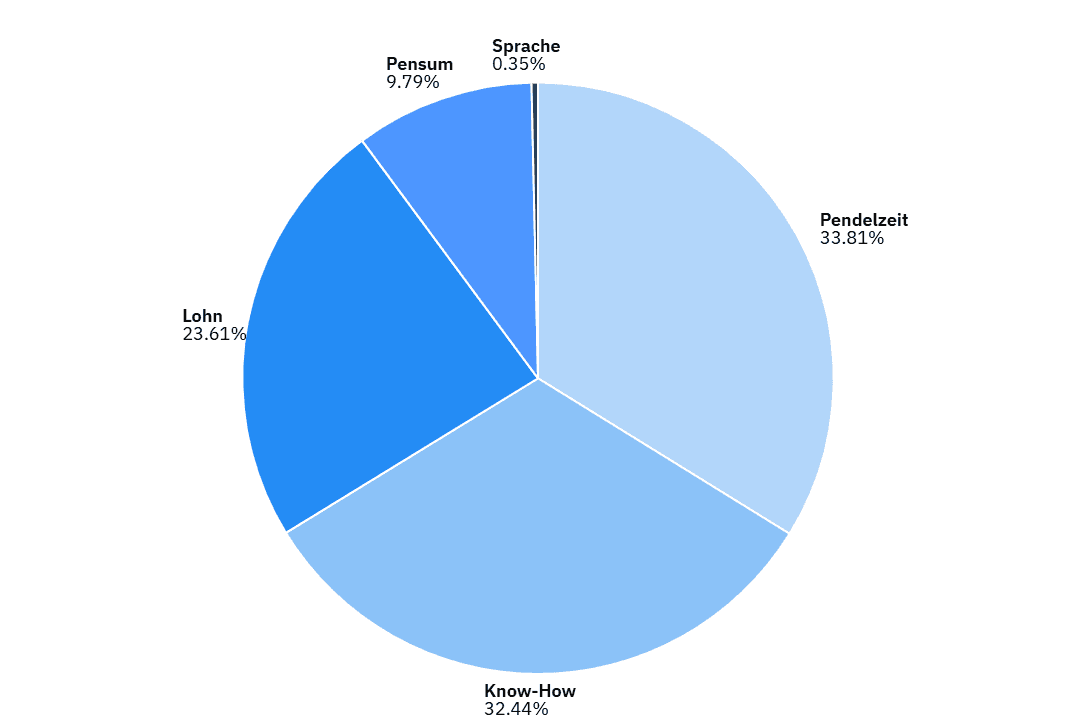
Figure: Distribution of the most common deviations for a perfect match
The commute is not a minor criterion
The most common reason for deviation in the evaluation is the commute. It accounts for around a third of all deviations.
This may sound unspectacular, but it is an important reality check in IT recruiting. Location, commute time, and home office regulations go hand in hand. A job can be a perfect professional match. But if the commute doesn't fit the talent's reality of life, it still won't make a strong match.
Particularly in a market where many IT roles work at least partially remotely, a rigid location logic quickly becomes a filter that unnecessarily excludes good talent.
Technologies remain important, but they don't explain everything
Almost as frequently as the commute, deviations in technologies and methodologies appear.
This shows that skills remain central. No question. Anyone looking for a specific technology, architecture, or methodology needs relevant experience.
But the data also shows that technology is only one part of the match. A pure keyword match falls short because it ignores other factors that can be at least as relevant to the decision.
The tech stack might fit, while salary or work model do not. Or vice versa: a talent can be methodologically very close to the job, but does not yet have a specific technology in their profile.
Salary belongs earlier in the process
Almost a quarter of all deviations relate to salary expectations.
This is a clear indication: salary is not a topic for the very end. If expectations and budget are far apart, even a professionally exciting profile is of limited help.
Of course, not every difference has to be an immediate exclusion. But if the salary only becomes visible late in the process, both sides invest time in a conversation that might have been unrealistic from the start.
Transparency here is not uncomfortable, but efficient.
Workload is smaller, but relevant
The workload also regularly appears in our data as a reason for deviation. Not as often as the commute, technology, or salary, but often enough to be relevant.
Especially in the IT sector, many talents do not think strictly in a 100 percent logic. Some look for 80 to 100%, others deliberately want to work part-time or are only open within certain ranges.
For companies, this means: the more narrowly a job's workload is defined, the smaller the suitable talent pool can become.
Good matching explains, not just sorts
The most important point from the evaluation, however, is not a single number, but the logic behind it.
A good matching should not just deliver a ranking list. It should explain why one talent is at the top, why another profile does not quite fit, and which criteria make the difference.
Because for recruiting teams, that is precisely what is valuable: not just seeing more profiles, but being able to make better decisions.
Where is a conversation worth it? Where is a deviation negotiable? Where is it a real dealbreaker? And where does an overly narrowly defined job perhaps exclude talents who would fundamentally be exciting? Learning this also makes future searches easier.
Conclusion: The most exciting part lies between yes and no
Matching is therefore not just a score or a magical answer to the question of who fits perfectly.
Good matching makes visible what is otherwise often only noticed late in the process: expectations, frameworks, working reality, and professional requirements must play together.
The data on seekme.io shows: there is a considerable number of perfect matches. But the larger part lies in the intermediate space. There, where talents are interesting, but individual criteria deviate.
It is precisely this intermediate space that is exciting.
Because recruiting does not get better if you just sort faster. It gets better when you understand earlier why a match could really work, or why not.